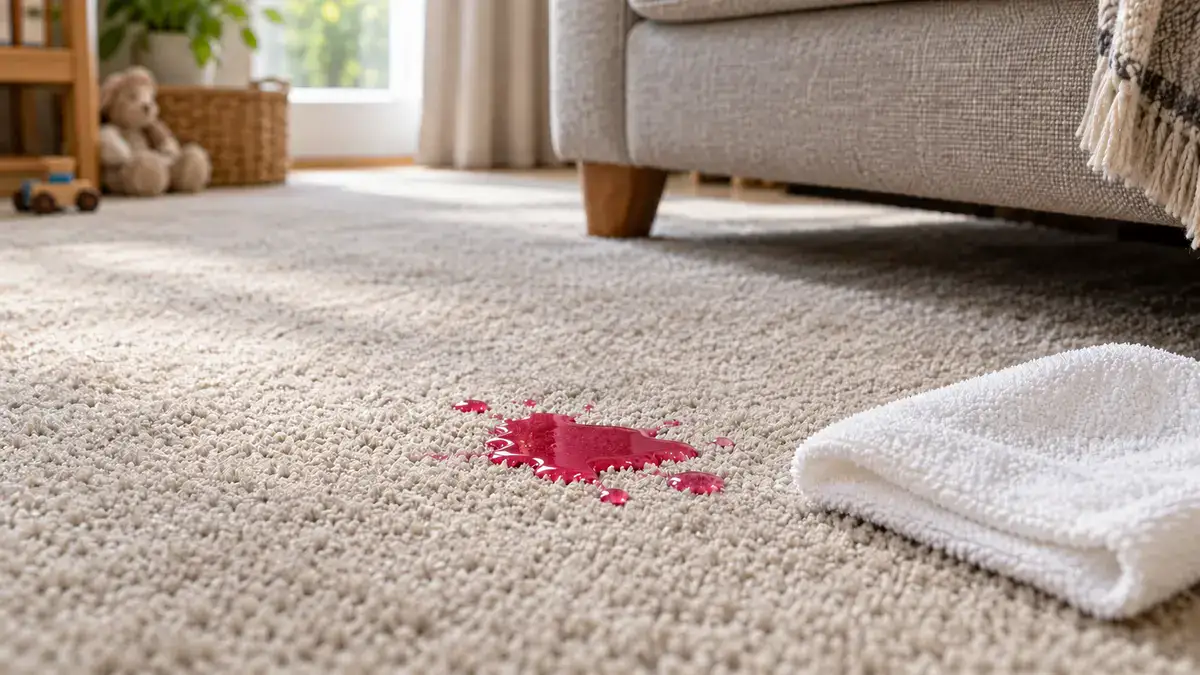
Calpol spills can be tricky to deal with. The syrup may seem easy to wipe up at first, but any residue left in the carpet can attract dirt and make the mark darker over time. The best first step is to act calmly, blot up as much as you can and avoid reaching for household cleaning products.
We’ve seen how a small spill can become a much more noticeable mark if it is walked over or cleaned with the wrong products. Here’s how to handle a fresh Calpol spill, what to do if it has dried, and when it may be time to ask a professional carpet cleaner for advice.
If the spill has just happened, try to absorb as much of it as possible before it works further into the carpet fibres. Use a clean, white, absorbent cloth or kitchen roll so you can see how much is transferring onto it.
It is important not to scrub. Carpet fibres can be damaged by vigorous rubbing, and scrubbing can push the syrup deeper or spread it across a larger area. Gentle blotting gives you the best chance of lifting the spill without creating a bigger problem.
It is tempting to use whatever carpet cleaner or stain remover you have under the sink. We understand why people try this, especially when a spill has happened in a busy household. But products that seem suitable for everyday cleaning can leave residue, affect the carpet colour or make it harder to treat the original stain professionally.
We advise against using household stain removers, washing-up liquid or similar products on the carpet unless a professional has recommended a specific treatment for it. We often see the results of well-intentioned cleaning attempts, including patches where a product has altered the carpet or left a mark of its own.
It is also best to avoid hot or warm water, scrubbing brushes and large amounts of water. Applying lots of water without professional extraction can leave moisture in the carpet and may cause water marks. If you have already tried a product, don’t keep adding more. Let us know what you used when you ask for advice, as that can help us assess the area.
A spill can leave sticky residue behind even after the visible liquid has been blotted away. Dust and soil can cling to that residue, particularly in areas where people walk regularly. The carpet may then appear darker, and the mark can become more noticeable as dirt builds up.
This is why a spill that looked minor at first can turn into a larger, darker patch. The visible stain may not tell the whole story. There can still be residue in the carpet fibres, and simply wiping the surface may not remove it.
If the area has already been walked over, avoid rubbing or trying to scrape it clean. Blot up anything that is still wet, then stop and get advice if the mark remains. Repeated attempts with different products can make it more difficult to work out what has caused the discolouration.
A dried spill can be harder to deal with because the syrup may have bonded with dirt or settled further into the fibres. You can gently blot the area with a cool, slightly damp cloth, but avoid soaking it or using a household stain remover to try to dissolve the mark.
If the mark is large, has turned dark, keeps returning or does not improve with gentle blotting, it is sensible to stop. The type and condition of the carpet, how long the spill has been there and anything already used on it can all affect the best approach. A technician can assess those factors before recommending a suitable treatment.
There is no single method that can safely remove every stain from every carpet. Some marks can be greatly improved, while others may leave some discolouration. We would rather give you a realistic view after assessing the carpet than promise a result before we know what we are dealing with.
Some years ago, an employee had an open bottle of Calpol in their backpack. As they walked up the stairs and across an open-plan office, the bottle left a sticky trail on the carpet. The residue was not dealt with straight away, and over time it attracted dust and soil. What had started as a spill became a long, wavy black line running up the stairs and across the office.
The office carpet was due for a refresh, so the team treated the affected areas as part of the wider clean. After assessing the carpet, Aqua-Dry used professional hot water extraction to remove the dark staining and extract the sticky residue. The important part was addressing the residue in the carpet, rather than only improving the visible surface mark.
That job is a useful example of how a sticky spill can change over time, especially in a high-traffic area. It does not mean every Calpol spill will develop in the same way or that every carpet will respond identically. The right treatment depends on the carpet and the condition of the stain.
Professional cleaning may help where a spill has left sticky residue or attracted dirt. Before cleaning, the technician needs to assess the carpet and consider its fibres, condition and any products that have already been used. A suitable method can then be chosen for that particular carpet.
For carpets that are suitable, hot water extraction can help rinse and extract soil and residue from the fibres. It is not appropriate for every carpet or every stain, so the technician will assess the material before deciding how to proceed. Even with professional equipment, complete stain removal cannot be guaranteed in every case.
If you are in Dublin and the Calpol mark is not improving, you can read more about Aqua-Dry’s carpet cleaning service. We can discuss the stain, ask what has already been tried and advise whether an assessment would be helpful.
If you have blotted up the spill but the mark remains, contact Aqua-Dry for advice. Our team can help you understand the next step and provide a quotation for professional carpet cleaning in Dublin.
Get a free carpet cleaning quote or call us on 01 840 0799.


